Small Apartment, Big Warmth: African Boho in 500 Sq Ft
African boho layers for about 500 square feet: zone with shelving, let textiles carry the color, and keep it all renter-friendly.
Disclosure: As an Amazon Associate I earn from qualifying purchases. How we earn.
This is the crossover guide — the one where our Afrohemian layer meets our small-space layer — and it is written for a real constraint: about 500 square feet, quite possibly a studio, quite possibly rented. The good news is that this style is unusually kind to small homes. Its warmth comes from textiles and woven texture, not from big furniture — and textiles fold, hang and move out with you.
How the pieces work together: zone the room, never wall it
A studio fails when it reads as one undifferentiated box, and it fails worse when a bookcase wall or curtain splits it into two dark halves. Zone instead: give each activity a visible territory while the light and air keep flowing.
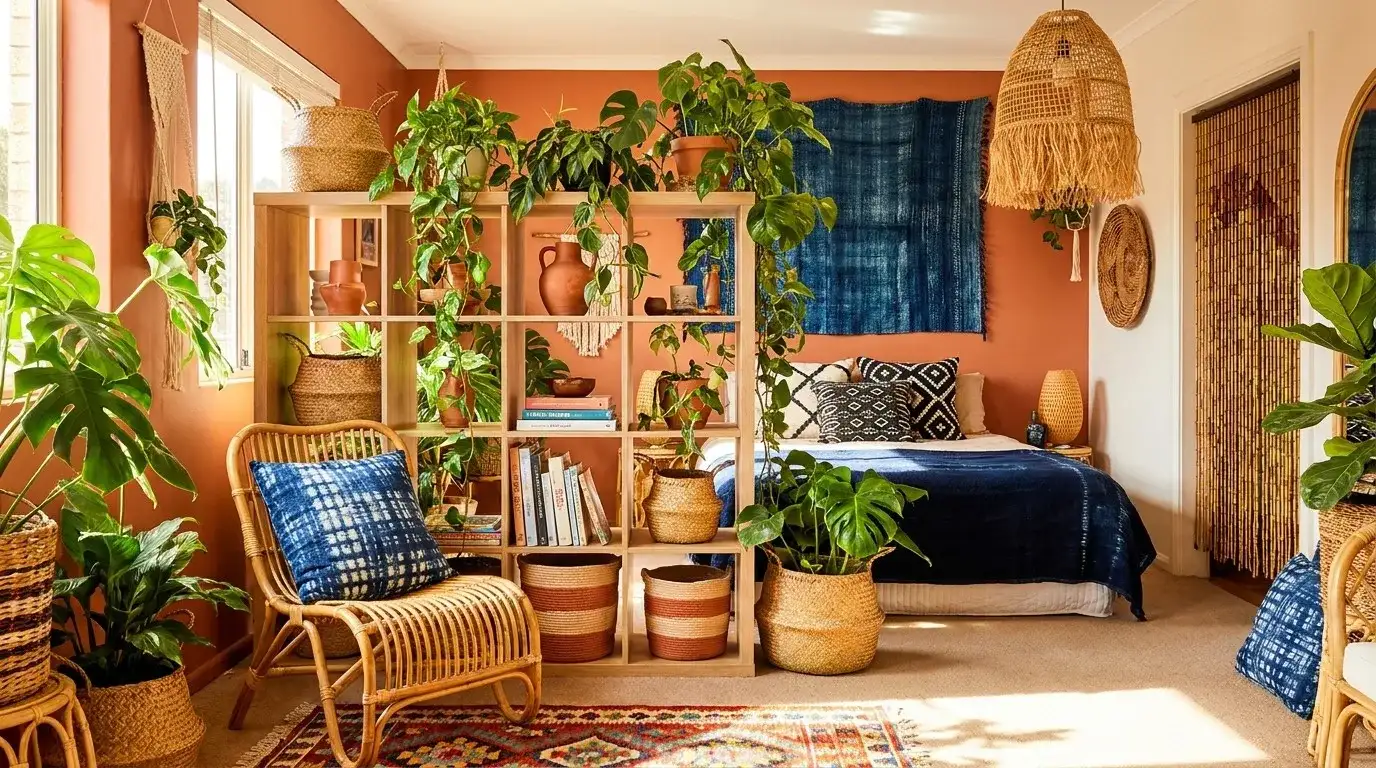
- Open shelving as the divider. A low, open shelf unit between the bed zone and the living zone is the hardest-working piece in a studio: it marks the border, stores books and baskets, and lets light pass through the gaps. Style it from both sides — it has two fronts.
- A rug under the living zone only. The rug’s edge is the border. Sofa and chair feet on the rug, bed off it, and the brain reads two rooms.
- A threshold, not a door. A beaded curtain or a textile hanging at the entry strip gives the psychological moment of arriving home, at zero construction cost.
- Light in pools. One lamp per zone, switched separately, does more zoning after dark than any furniture move.
Choose small, light and double-duty
- Armless and leggy wins. A compact rattan chair without arms, raised on legs, takes less visual and physical space than any upholstered armchair — and it is this style’s hero piece anyway.
- One anchored seating piece, maximum. A loveseat or a two-seat sofa is the ceiling in 500 square feet; everything else that seats people should be a stool, a floor cushion or a basket-side pouf that can move.
- Storage that is also the decor. Seagrass baskets hold blankets, chargers and clutter in the open. In a small home, closed storage is scarce — beautiful open storage is the workaround.
- Measure the walkway, not the wall. Keep one clear path of roughly 24–30 inches from door to window. If a piece narrows the path, the piece is too big, whatever the tape measure says about the wall.
Let textiles carry the color
In a small or rented home, the smartest division of labor is this: furniture stays neutral and forgettable, and textiles do all the expressing. One indigo hero textile per zone — a throw in the living zone, a runner or duvet in the sleep zone — plus black-and-white geometry in the cushions gives the full Afrohemian effect with a shopping list you can carry in one bag. When you tire of it, or move, the entire color scheme rolls up into that same bag. Nothing to repaint, nothing to sell.
A note on textiles
Real adire is Yoruba cloth from Nigeria, resist-dyed by hand in indigo. The throw in this guide is a factory print inspired by that tradition, and we label it that way. The same rule runs across the site: inspired-by pieces are named as inspired, and artisan-made pieces name their maker.
The renter rules: no drilling, no painting
- Walls: basket walls and textile hangings go up on rated adhesive hooks or over-door hooks; a tension rod inside a window or doorway frame carries a light curtain or hanging with no fixings at all.
- Color without paint: the textile layer is the paint job. A large indigo hanging behind the sofa changes the room more than one painted wall would — and comes down in a minute at move-out.
- Floors: a jute or woven rug over tired rental flooring protects both the floor and your deposit, and defines the living zone at the same time.
- Keep the evidence bag: photograph every wall and floor on move-in day. Renter-friendly decor plus dated photos is how a deposit comes back in full.
Before you buy
Spend in the order the room is read: rug first (it sets the zone), the open shelf second (it sets the border), the compact chair third, then the two hero textiles, then baskets. Wall pieces and accents come last, bought only for gaps you can actually see. Most small apartments are ruined by buying in the reverse order — a cart of charming small objects with no structure to land on. Check dimensions and materials on the retailer’s page before ordering, and measure your walkway, not just your walls. Prices and availability change daily; the price that applies is the one Amazon shows when you check out.
Shop the look — 5 pieces
- Room divider
Low open shelving unit
The border between the bed zone and the living zone — styled from both sides, with light passing through.
Splurge Check price on Amazon - Hero seat
Compact armless rattan chair
Leggy and light, it takes less visual and physical space than an upholstered armchair and keeps the walkway clear.
Splurge Check price on Amazon - Color layer
Adire-inspired indigo throw
The living zone's one hero textile — printed, inspired by Yoruba adire, and labeled inspired by.
Inspired-by design — not the traditional handmade cloth
Under $50 Check price on Amazon - Open storage
Woven seagrass baskets (set of 3)
Storage that doubles as decor, on the divider shelf and beside the chair — the workaround for scarce closet space.
Under $50 Check price on Amazon - Threshold
Bamboo beaded curtain
A no-build threshold for the entry strip or a closet doorway — hangs from a rod and moves out with you.
Mid-range Check price on Amazon
Materials: Rattan, Adire-inspired textiles, Seagrass, Jute, Bamboo