African Boho Living Room Guide: Warm, Layered Style
The living-room guide: a four-pass layering order, the mud, indigo, ochre and cream palette, and the five mistakes that flatten the room.
Disclosure: As an Amazon Associate I earn from qualifying purchases. How we earn.
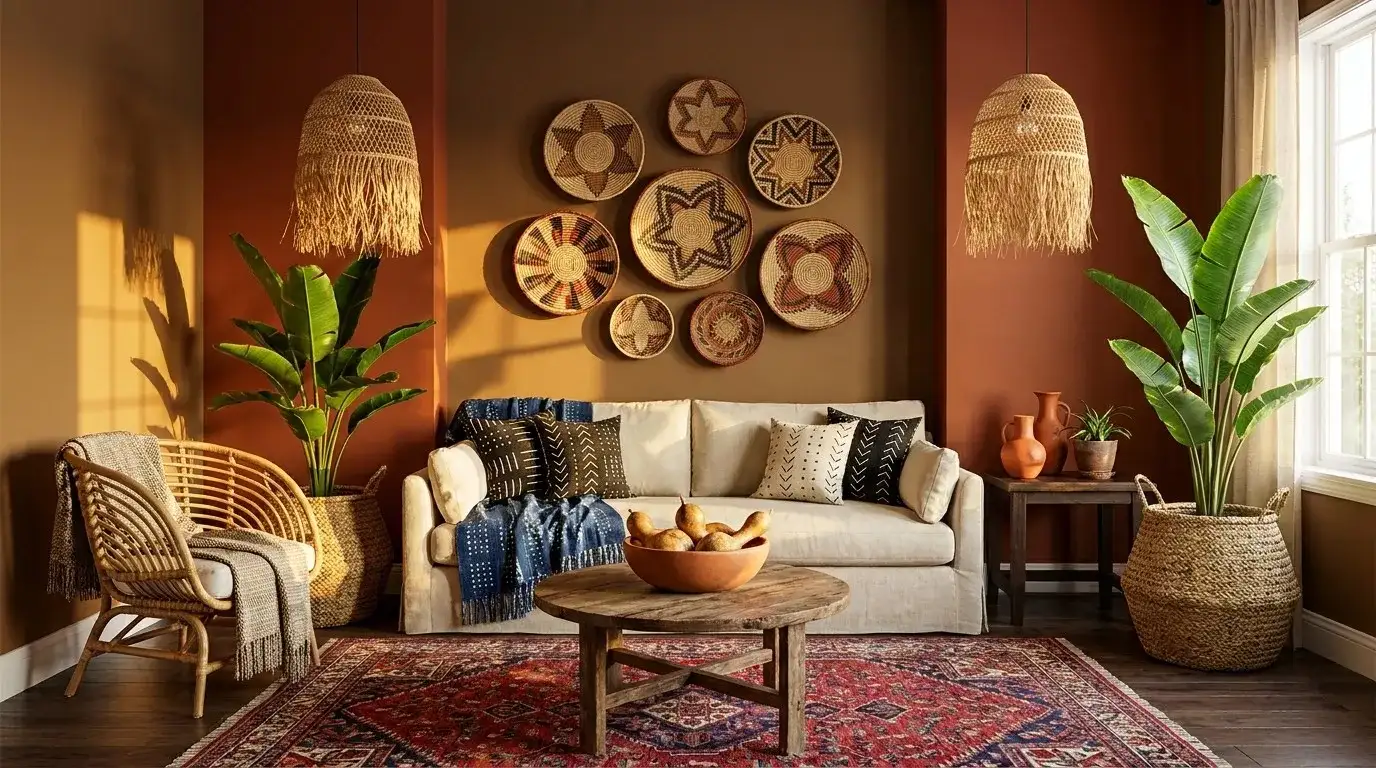
This is the room our very first pin shows — and the question it always raises is the same: how do all those layers end up looking calm instead of cluttered? The answer is order. An African boho living room is built in four passes, each one with a single job. Follow the order and the room almost styles itself; skip a pass, or run them backwards, and the same pieces fight each other.
How the pieces work together
- Pass 1 — the neutral base. Walls, the sofa and the largest rug stay quiet: cream, warm white, undyed linen, natural jute. This base is roughly two-thirds of what the eye sees, and it is what makes everything after it readable. If your base already has a strong color or pattern, the later passes have to be quieter — one loud layer per room is the budget.
- Pass 2 — the textile layer. This is where the color and pattern arrive: cushions, one throw, a runner or a wall hanging. Indigo and black-and-white geometry do most of the work here. Textiles are also the cheapest layer to change, so they carry the risk — buy the bold pattern here, not in the sofa.
- Pass 3 — rattan and wood. One or two woven or wooden pieces give the room its structure and height: a rattan chair, a wooden side table, a woven pendant. Same material family, repeated twice, reads as a deliberate set; five different woods read as a yard sale.
- Pass 4 — the small warm accents. Terracotta, aged brass and clay are seasoning, not structure: a vase, a bowl, a lamp base. Two or three pieces, placed where the eye lands — the coffee table, the shelf at eye level, beside the chair. If an accent is the first thing a guest notices, there is too much of it.
Four colors run the whole room. Cream is the ground. Mud — the warm brown-grey of earth and unglazed clay — is the bridge between the furniture and the floor. Indigo is the single deep color, used in the textile layer only. Ochre is the spark: one cushion, one pot, one stripe in a throw, never a whole wall.
A useful test before you buy anything: photograph the room in black and white. If the shapes still read — a light base, one dark textile moment, mid-tone wood — the color version will work. If the photo is a grey blur, the problem is contrast, not color.
Choosing the rattan chair
- Measure the footprint first. A peacock chair is a statement and a space claim — in a small room, choose a tub or barrel shape with a footprint under roughly 30 inches wide, and keep at least 24 inches of walkway around it.
- Sit depth beats looks. For a reading chair, look for a seat depth around 20–22 inches and a back that reaches your shoulder blades; a shallow, upright frame is a perch, not a chair.
- Check the weave and the joints. Tight, even weaving with no broken strands, and wrapped joints at the arms and legs. Rattan bends — it should flex slightly, never creak or wobble.
- Plan the cushion at purchase time. A plain cream or mud cushion keeps the chair in the palette and lets one patterned pillow do the talking.
Hanging the woven wall
The basket wall above the sofa is the signature of this room, and it follows three rules. First, work in odd numbers — five or seven pieces read as a composition, four reads as a grid. Second, lay the arrangement on the floor and photograph it before anything touches the wall; move pieces until the largest basket sits slightly off-center and the group has one clear outline. Third, keep the whole group within the width of the sofa below it, with the lowest basket at least 8 inches above the back cushions. Renters: rated adhesive hooks and picture ledges do this job with no drilling at all.
A note on textiles
Real adire is Yoruba cloth from Nigeria, resist-dyed by hand in indigo. Bogolan (mudcloth) comes from Mali. The throw, pillow covers and prints in this guide are inspired by those traditions, and we label them that way in every product name. When an artisan-made version is available from African makers, we will add it and name who made it.
Five mistakes that flatten this room
- Every pattern at the same scale. One large-scale print, one medium, one small — if two patterns compete at the same size, the eye gives up.
- Buying the accents first. Vases and bowls are fun to buy and impossible to build a room on. Base, textile, structure — then accents.
- A matching set of everything. Identical cushions, identical baskets, identical side tables read as a showroom package, not a collected home. Repeat materials, vary shapes.
- Cold, white light. This palette is built for warm light. A cool bulb turns cream grey and indigo black; use warm bulbs and at least one low lamp instead of a single ceiling light.
- Nothing alive or tall. Without one plant or one tall piece, the room sits at sofa height and feels staged. Height is a layer too.
Before you buy
Measure the chair footprint and the walkway around it, and the wall width above the sofa before ordering baskets. Check dimensions, materials and care information on the retailer’s page — especially seat depth on the chair and the rug size against your seating group. Prices and availability change daily; the price that applies is the one Amazon shows when you check out.
Shop the look — 6 pieces
- Structure
Rattan accent chair (tub or barrel shape)
Pass 3 in the layering order — the structure piece, chosen by footprint and seat depth before looks.
Splurge Check price on Amazon - Color layer
Adire-inspired indigo throw
Pass 2 — the deep color layer over the sofa arm. A printed textile inspired by Yoruba adire, always labeled inspired by.
Inspired-by design — not the traditional handmade cloth
Under $50 Check price on Amazon - Pattern balance
Mudcloth-inspired pillow covers (set of 2–4)
Black-and-white geometry at medium scale, balanced against the indigo. Inspired-by prints, not bogolan cloth.
Inspired-by design — not the traditional handmade cloth
Under $50 Check price on Amazon - Wall layer
Woven wall baskets (set of 5–7)
The wall composition — odd numbers, laid out on the floor first, hung on rated hooks within the width of the sofa.
Mid-range Check price on Amazon - Floor ground
Jute area rug
Pass 1 — the neutral ground that holds the seating group together and quiets everything above it.
Mid-range Check price on Amazon - Warm accent
Terracotta vase or table lamp
Pass 4 — one piece of fired clay where the eye lands. Seasoning, not structure.
Under $50 Check price on Amazon
Materials: Rattan, Adire-inspired textiles, Mudcloth-inspired textiles, Terracotta, Jute, Seagrass